

One system for a handmade rug, from the yarn estimate to the delivered piece
Lapchi makes custom and stock handwoven rugs, in patterns drawn from centuries of art, design and culture. The operation runs across vendors, partners and multiple locations. We built the ERP and CRM it runs on: order confirmation, online carpet designing, yarn estimation, the full production life cycle, inventory and shipments, in one application, built out feature by feature from 2017.
- Industry
- Retail / Handwoven rugs
- Duration
- 9 years
- Team
- 2 to 5 engineers
- Client satisfaction
- 5 / 5
Why generic software does not fit
Off-the-shelf inventory and manufacturing systems assume interchangeable units. A thousand identical widgets move through identical steps, and the software counts them.
Nothing at Lapchi is interchangeable. Every rug is its own specification: its own design and colorway, its own silk percentage, its own knot count, its own dye formula, its own dimensions. Two orders that look alike on paper can need different yarn, a different weaving technique and different finishing. Generic ERPs have nowhere to put any of that, and spreadsheet tracking falls apart the moment production runs across several locations at once.
What the system had to hold
In the client’s own words, the requirement was a custom ERP covering the entire operation: vendors, partners, different locations, order processing, online carpet designing, yarn estimation, and the complete production life cycle of the carpet. On top of that, a CRM, inventory management and shipments.
The harder part of the brief was the last clause. It had to be a system that could keep evolving with the business rather than one that would need replacing in five years.
What we built
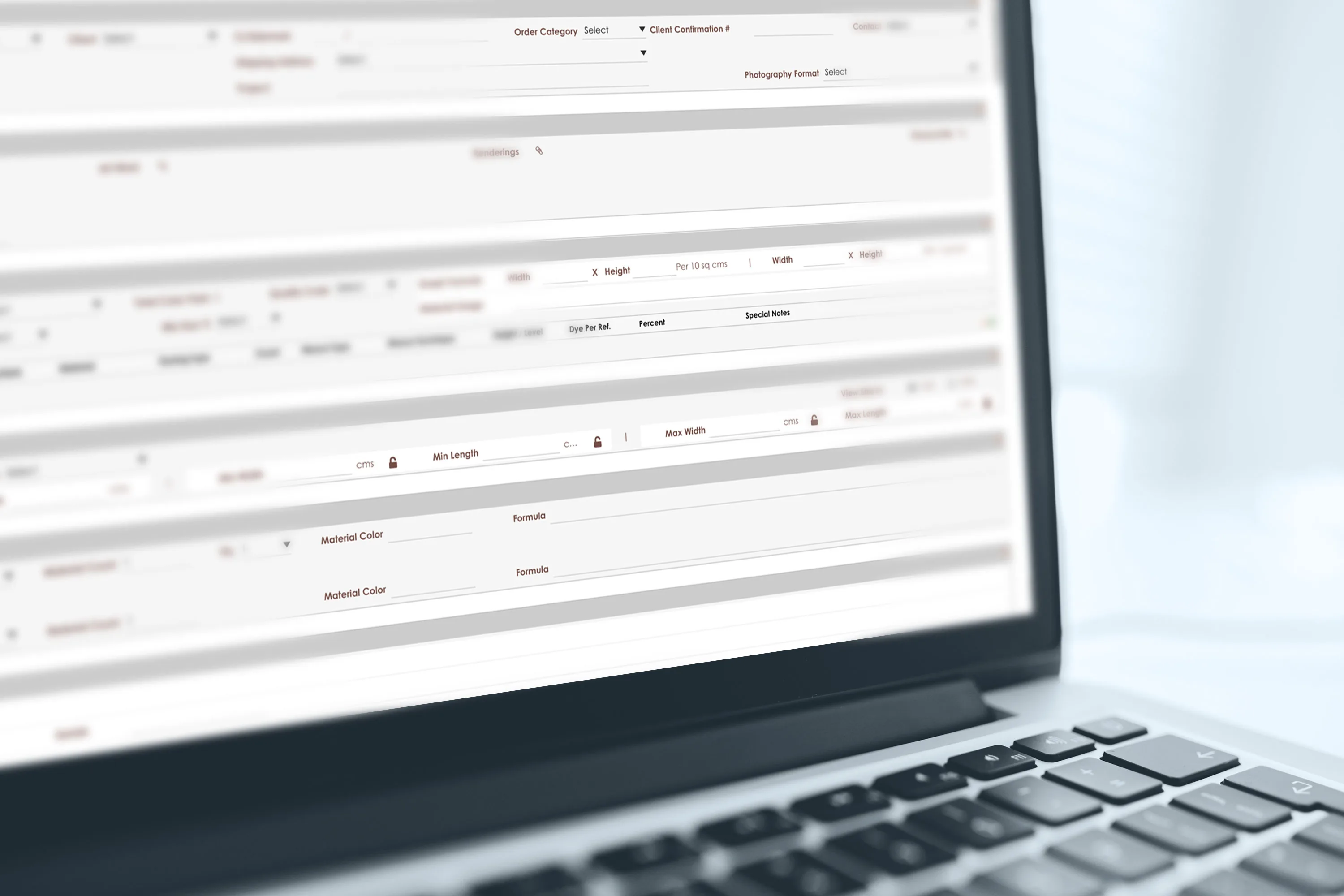
- Order confirmation, holding client, design, colorway, quality, dimensions and shape
- Material specification down to fibre composition, such as a blend of Tibetan wool, linen and Bhutan silk
- Dye formulas and material colour recorded per reference, with percentages against dye levels
- Weaving specification: warp and knot detail, dyeing type, weave type, wash technique, pile height, silk percentage, twist and complexity
- Yarn estimation driven by size, density and pattern, priced per unit area
- Online carpet designing, with reference material, renderings and photography format attached to the order itself
- Production tracking across the full life cycle, with weaver assignment and progress
- Inventory management with granular real-time reporting
- Shipments and logistics, from studio to international client, with estimated dates, shipping detail, confirmation and purchase order numbers
- A CRM joined to the same records, so an enquiry and the piece it becomes are one thread
- Accounting joined to order, production and shipping data, including extra charges
What that looks like in practice
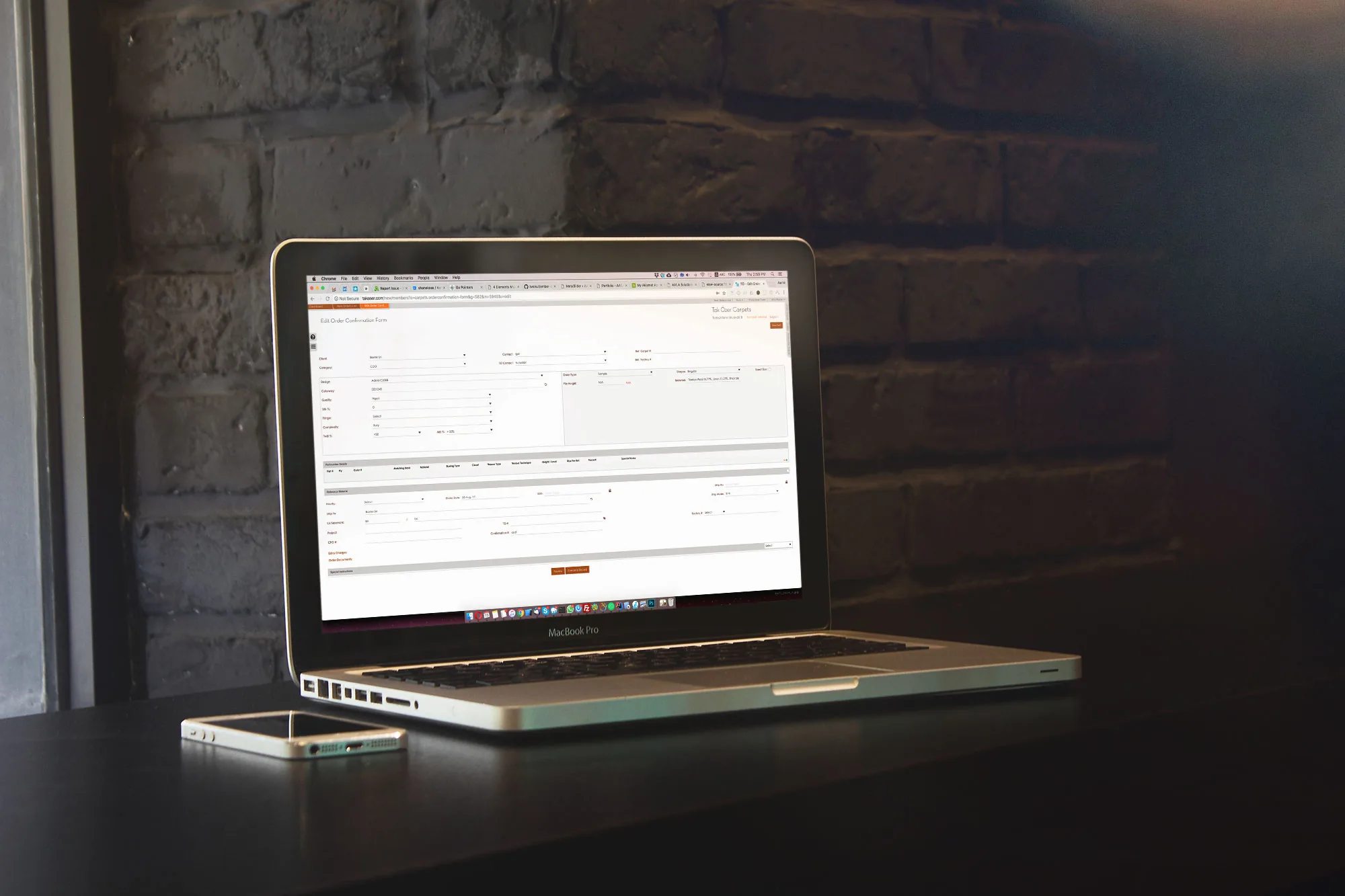
The order confirmation screen is the centre of it. One record carries the commercial side, the client and the confirmation numbers, alongside the manufacturing side, the fibre blend, the dye percentages and the weaving technique, alongside the logistics, the ship-to address and the estimated departure. A studio manager can answer any question about a piece without leaving the record or opening a spreadsheet.
How the engagement ran
A project manager, work tracked in Git, tickets managed properly and a release cycle the client could see. Communication ran through Zoom, Slack, WhatsApp and email, and the whole team answered directly rather than through an account layer.
We also managed the server the application ran on, a VPS with PHP extensions compiled from source and OpenSSL configured for Google SSO.
What it changed
The figures below are the client’s own, reported to Clutch in a verified review.
Over 40 percent improvement in overall operational efficiency, with work that used to take hours completing in minutes. Around 25 percent reduction in administrative expenses and overhead, from removing manual processes and data entry errors. Inventory levels optimised and stockouts reduced through real-time reporting on granular detail. Dashboards and drill-down reporting that gave the management team visibility it did not previously have.
Where we fell short
The client’s one criticism, published alongside the rest: technical documentation ran behind the progress of the application. That is a fair call and worth recording next to the results.
The stack
Laravel for the application layer and Ember.js for the interface, on MySQL, deployed to a VPS we maintained. Both framework choices were ours to propose, and the system was built incrementally, feature by feature, as the studio’s operation grew.
Screens
Client feedback
Their professionalism, attention to detail, and dedication to meeting our needs have exceeded our expectations.
From the very beginning, AALA IT Solutions demonstrated a profound understanding of our needs and objectives. They not only developed our online system from scratch but also continuously upgraded and maintained it over the years, ensuring it remained at the forefront of technological innovation and efficiency.
They provided us with a project manager, and all the tasks are posted and updated on GIT. All tickets are properly managed and a proper release cycle is implemented. This showed us the overall picture of where things stand and all completed and ongoing tasks.
What was most impressive was their openness to changes, and constructive input. Continuous evolvement towards the needs.
NoorCTO, Lapchi LLC
What next
Running something like this?
The engineers who built this are the ones you would work with. Tell us what you have and we will tell you plainly whether it is work we should take.